How to Fix Black Screen When Launching Games (2026 Guide)
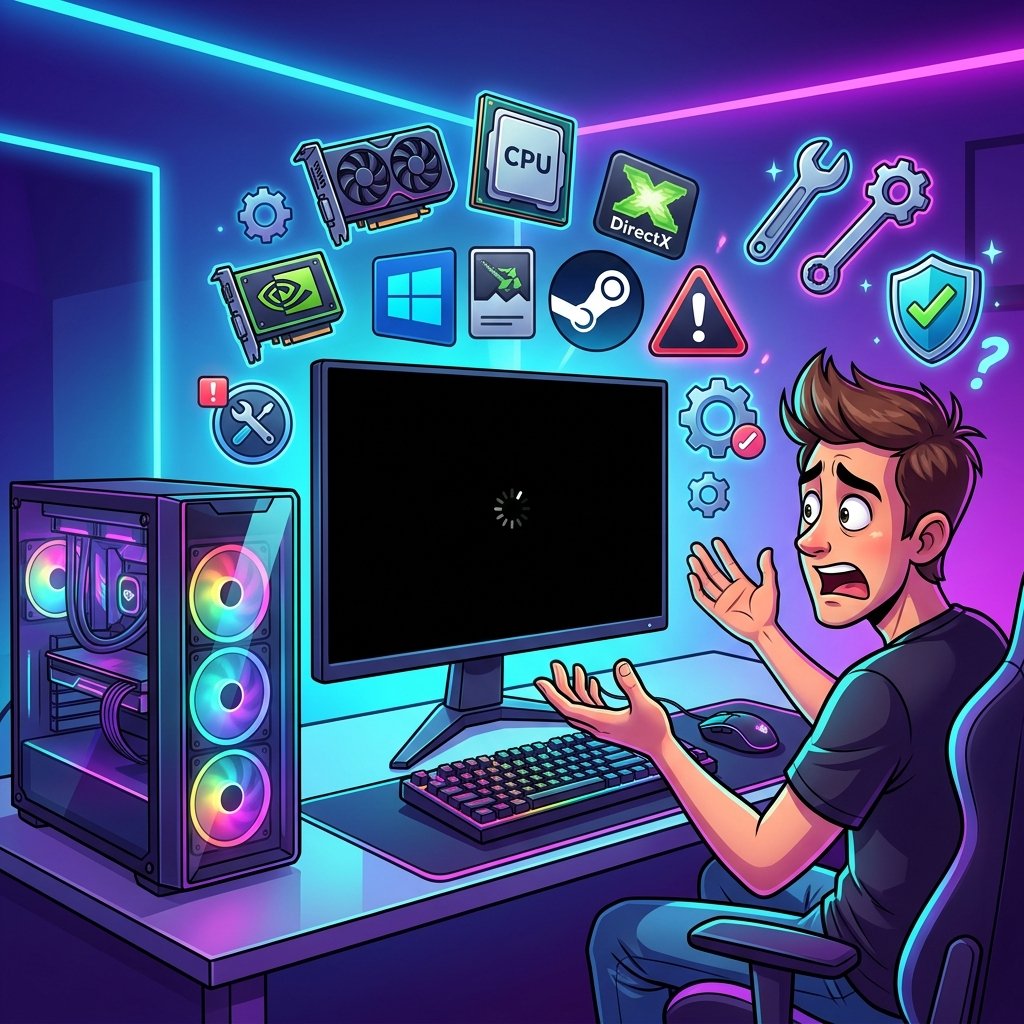
You hit play, the loading music kicks in, and then… nothing. Just a black screen. Sometimes you can still hear menu sounds or gameplay audio, which makes it even more confusing — is the game actually running, or did it crash?
A black screen when launching games isn’t one specific bug. It’s a symptom that can trace back to a graphics driver, a Windows Update, a display setting, a corrupted game file, or even a loose cable. That’s exactly why so many “10 quick fixes” lists don’t work for everyone — they treat every black screen the same way, when the real fix depends on which pattern you’re seeing.
This guide is built differently. It starts by helping you narrow down why your screen is going black, then walks through fixes in the order that actually solves the problem fastest — starting with the quick wins, then driver and Windows-level fixes, then the game-specific and hardware checks most other guides skip. It also covers a Windows Update issue from early 2026 that’s been a real, documented cause of this exact problem, so if you’re troubleshooting this in 2026, start there before you spend an hour reinstalling drivers.
Whether you’re a casual player who just wants the game working again or someone comfortable digging into Event Viewer logs, you’ll find the right depth of fix here.
What Causes a Black Screen When Launching Games?
Before changing any settings, it helps to know what you’re actually dealing with. The exact pattern of your black screen — whether there’s audio, how long it lasts, and when it happens — points to a different root cause. Matching your symptom to the right category below will save you from trying fixes that were never going to work.
Black Screen With Audio Still Playing (Game Is Running, Display Isn’t Updating)
If you can hear music, voice lines, or menu sounds but see nothing, the game itself has launched successfully. The problem is happening at the display output stage — usually the graphics driver failing to render a frame, a display mode mismatch, or Windows’ compositor (the system that manages what appears on screen) getting stuck mid-handoff between the game and your desktop.
This pattern points toward driver issues, Fullscreen Optimizations conflicts, or Hardware-Accelerated GPU Scheduling problems — all covered further down.
Black Screen With No Audio (Launch Failure, Crash, or Runtime Issue)
If there’s total silence — no music, no sound effects — the game likely isn’t running at all. It may have crashed immediately after launch or failed to start because of a missing dependency, like a DirectX component or Visual C++ Redistributable package.
This pattern points toward corrupted game files, missing runtimes, or a launcher-level failure rather than a display problem.
Black Screen That Resolves Itself After a Few Seconds
A brief black screen — one to five seconds — that then resolves into the game is often just your monitor renegotiating its signal. This happens when the game switches resolution or refresh rate from your desktop settings, and the display briefly has to resync. It’s usually harmless, though it can point to a marginal cable if it happens on every single launch and lasts longer than a couple of seconds.
Black Screen Only in Fullscreen, or Only After Alt-Tabbing Back In
If the game works fine in windowed or borderless mode but goes black specifically in exclusive fullscreen, or goes black when you alt-tab away and then back, this is a strong signal pointing to Fullscreen Optimizations or Hardware-Accelerated GPU Scheduling — Windows features that manage how a game takes over your display, and which sometimes conflict with specific driver versions or monitor setups.
Quick Fixes to Try First (5 Minutes or Less)
These won’t fix every case, but they solve a surprising number of black screen issues with almost no effort. Try these before moving into driver or Windows-level troubleshooting.
Restart Your PC and Relaunch the Game
Why this works: A simple restart clears out any stuck background processes, resets your GPU driver state, and closes any overlay or launcher process that might be holding a lock on display resources.
Steps:
- Fully close the game and your game launcher (Steam, Epic Games, etc.) via Task Manager if they don’t close normally.
- Restart your PC — not just sign out, a full restart.
- Launch the game directly, without opening other heavy applications first.
Expected result: If the black screen was caused by a temporary stuck process or driver state, the game should launch normally.
If it doesn’t work: Move on to the display fixes below — this rules out “temporary glitch” as the cause.
Try Ctrl+Alt+Shift+B to Reset the Display Driver
Why this works: This built-in Windows shortcut forces a soft reset of your graphics driver without restarting your PC. Your screen will flash or briefly go black, then come back — that’s expected.
Steps:
- While the game is black-screened, press Ctrl + Alt + Shift + B.
- Wait a few seconds for the screen to flash and recover.
- Check if the game is now visible.
Expected result: If the issue was a temporary driver hang, the game should reappear.
If it doesn’t work: Force-close the game and try launching it fresh instead of waiting.
Note: This shortcut doesn’t work on every system — some laptops and OEM configurations disable it. If nothing happens after a few seconds, it’s simply not supported on your setup.
Switch the Game to Windowed or Borderless Windowed Mode
Why this works: Exclusive fullscreen mode gives the game direct control over your display, which is where most black screen conflicts happen. Windowed and borderless windowed modes let Windows’ compositor keep managing the display, which sidesteps many of these conflicts entirely.
Steps:
- If you can access the game’s settings menu (even blind, using memorized menu positions), switch Display Mode to Windowed or Borderless.
- If you can’t see anything at all, check whether the game has a config file (often in
Documents\<Game Name>or%appdata%) where display mode can be edited manually.
Expected result: If your black screen is a fullscreen-specific display conflict, windowed or borderless mode should let the game display properly.
If it doesn’t work: The cause is likely deeper than display mode — move on to driver and Windows-level fixes.
Check Your Monitor Cable, Port, and Input Source
Why this works: A loose or marginal HDMI/DisplayPort cable can fail specifically under the higher bandwidth demand of a game launch, even if your desktop looks fine. This is one of the most overlooked causes because everything appears normal until the game tries to push a new resolution or refresh rate through the connection.
Steps:
- Confirm the cable is fully seated at both the GPU and monitor ends.
- Try a different cable if you have one, ideally a known-working HDMI 2.1 or DisplayPort 1.4 cable.
- Try a different port on both the GPU and the monitor.
- Confirm your monitor is set to the correct input source.
Expected result: If this resolves it, the original cable or port was likely marginal for your resolution/refresh rate combination.
If it doesn’t work: Cabling is ruled out — proceed to the software-level fixes.
Check for Known Windows Update Issues (2026 Update)
This is the section most other black screen guides are missing, and it’s directly relevant if you’re troubleshooting this in 2026.
Microsoft’s January 2026 cumulative update (KB5074109) introduced a well-documented black screen problem affecting a range of systems, with Nvidia GPU users especially likely to see it — random black screens for several seconds, sometimes paired with graphical artifacts in games. Microsoft acknowledged the issue, and an optional follow-up update (KB5074105) addressed part of it before the February 2026 cumulative update (KB5077181, corresponding to builds 26200.7840/26100.7840) rolled in a broader fix. Independent testing after the February update showed improvement, though community reports through mid-2026 suggest it isn’t a universal fix for every hardware combination.
If your black screen issue started right after a Windows Update — and especially if it started in January or February 2026 — this is worth checking before you spend time reinstalling drivers or reseating hardware.
How to Check Your Current Windows Build Number
Why this works: Knowing your exact build tells you whether you already have the fix installed, or whether you’re still on a version with the known issue.
Steps:
- Open Settings > System > About.
- Look at the OS Build number.
- Compare it against Microsoft’s Windows release health dashboard for any currently listed known issues affecting graphics or games.
Expected result: You’ll know whether you’re behind on updates, on the build with the known issue, or already on a build with the fix applied.
Known Black Screen Issues Tied to Recent Cumulative Updates
Why this works: Confirming your symptom matches a known, documented issue (rather than something unique to your hardware) tells you the fix is likely a Windows Update, not a driver reinstall or hardware repair.
Steps:
- Check Settings > Windows Update > Update history for recently installed updates.
- Cross-reference the KB number against Microsoft’s support documentation for known graphics or gaming issues in that release.
- If your GPU is Nvidia and your issue started after a January or February 2026 update, this is a strong match.
Expected result: Confirmation that your issue is a known, Microsoft-acknowledged bug rather than a hardware fault — which changes your next step significantly.
Installing the Latest Cumulative Update vs. Rolling One Back
Why this works: In most cases, installing the newer cumulative update that contains the fix is safer and more effective than rolling back, since a rollback only restores your previous (also imperfect) state temporarily.
Steps:
- Go to Settings > Windows Update and check for updates.
- Install any available cumulative update, including optional updates if Microsoft has flagged a graphics-related fix.
- Restart and retest the game.
Expected result: If your black screen matches the known January/February 2026 issue, the current cumulative update should resolve it.
If it doesn’t work: Move to the rollback option below, or continue to the driver section — the issue may be compounded by an outdated driver as well.
When (and How) It’s Safe to Uninstall a Recent Update
Why this works: If installing the latest update doesn’t help, or you can’t install it yet, temporarily removing the update that introduced the regression can restore stability while you wait for a permanent fix.
Steps:
- Go to Settings > Windows Update > Update history > Uninstall updates.
- Select the specific KB update installed around when the issue started.
- Uninstall it and restart.
Important: Windows only allows uninstalling a cumulative update for a limited window after installation — usually about 10 days. If that window has passed, this option won’t be available, and you’ll need to wait for the next update to include a fix, or move on to driver-level troubleshooting instead.
Fix Graphics Driver Issues
Outdated, corrupted, or freshly-updated graphics drivers are the single most common cause of black screens on game launch. This section covers both general driver troubleshooting and vendor-specific steps for Nvidia and AMD.
Update Your GPU Driver the Right Way
Why this works: Game developers optimize for current driver versions, and GPU vendors regularly patch display pipeline bugs. An outdated driver may simply not know how to handle a specific game’s display request correctly.
Steps:
- Identify your GPU model via Device Manager > Display adapters.
- Download the latest driver directly from Nvidia, AMD, or Intel — not a third-party download site.
- Run the installer and choose a clean install option if available.
- Restart your PC after installation.
Expected result: If the black screen was tied to a driver bug, the game should now launch normally.
Important: A clean driver installation can cause a brief black screen during the install itself — this is normal. Don’t force a restart mid-installation; let it complete.
If it doesn’t work: Continue to the vendor-specific sections below, or try a full clean reinstall using DDU (covered further down).
Nvidia-Specific Black Screen Fixes
Nvidia App vs. GeForce Experience Driver Install Issues
Nvidia’s redesigned Nvidia App, which is replacing GeForce Experience, has had rocky driver releases in early 2026, with users reporting black screens tied to specific driver versions immediately after installation. If your black screen started right after a driver update through the Nvidia App, this is a likely cause.
Steps:
- If you’re mid-installation and stuck on black, wait — don’t force a shutdown. If it’s genuinely frozen for more than several minutes, force a restart and reinstall using a clean install option.
- If the issue persists after installing through the app, download the driver directly from Nvidia’s website instead and install that version manually.
- Consider installing the previous stable driver version if the newest release is causing issues, available from Nvidia’s driver archive.
Expected result: Installing directly from Nvidia’s website, rather than through the app, resolves installation-related black screens for many users.
Power Management and Driver Settings That Affect Black Screens
Why this works: Nvidia Control Panel’s power management setting affects how aggressively your GPU throttles between idle and full performance states — an overly conservative setting can cause instability during the demanding transition of launching a game.
Steps:
- Open Nvidia Control Panel > Manage 3D settings.
- Set Power management mode to Prefer maximum performance.
- Apply and relaunch the game.
Expected result: More consistent performance during game launch, with reduced likelihood of a power-state-related black screen.
AMD Radeon-Specific Black Screen Fixes
Adrenalin Driver Conflicts and Chipset Driver Mismatches
Why this works: AMD Radeon Software (Adrenalin) driver updates sometimes conflict with outdated AMD chipset drivers, which manage communication between your CPU and GPU. A mismatch here can manifest as a black screen or a “driver timeout” event during launch.
Steps:
- Update Radeon Software to the latest version from AMD’s support page.
- Separately, check your motherboard manufacturer’s site (or AMD’s chipset driver page for AMD-based boards) for the latest chipset driver.
- Install both, restart, and retest.
Expected result: Eliminating the version mismatch between GPU and chipset drivers often resolves black screens tied to “Driver Timeout Detection and Recovery” errors.
Smart Access Memory (SAM) as a Possible Trigger
Why this works: Smart Access Memory (AMD’s implementation of Resizable BAR) can cause instability on some newer Radeon GPU and motherboard combinations, occasionally manifesting as a black screen crash during gameplay or launch.
Steps:
- Restart your PC and enter BIOS/UEFI settings.
- Locate the Smart Access Memory or Resizable BAR setting.
- Disable it, save, and restart.
- Retest the game.
Expected result: If SAM was the trigger, disabling it should eliminate the black screen, though you may lose the small performance benefit it provides in supported titles.
How to Do a Clean Driver Reinstall With Display Driver Uninstaller (DDU)
Why this works: A standard driver update can leave behind conflicting leftover files from previous installations. DDU removes all traces of your current graphics driver, giving you a genuinely clean slate for a fresh install.
Steps:
- Download Display Driver Uninstaller from its official source.
- Restart your PC into Safe Mode.
- Run DDU and select your GPU manufacturer, then choose “Clean and restart.”
- After restart, install the latest driver directly from Nvidia, AMD, or Intel’s website.
Expected result: A genuinely clean driver state, which resolves black screens caused by corrupted or conflicting leftover driver files — a fix many users report succeeding with after standard reinstalls failed.
Important: This is a more advanced step. Only use DDU if standard driver reinstalling hasn’t worked, since it temporarily removes display drivers entirely — your resolution will drop to a basic default until the new driver installs.
When to Roll Back to a Previous Driver Version Instead of Updating
Why this works: If your black screen started immediately after a driver update, the newest driver itself may be the cause rather than the fix.
Steps:
- Note the exact driver version currently installed (Device Manager > Display adapters > Properties > Driver tab).
- Visit your GPU manufacturer’s previous drivers archive and download the version that predates your update.
- Use DDU (above) to fully remove the current driver first for a clean rollback.
- Install the older driver and restart.
Expected result: If a specific new driver release introduced the bug, reverting resolves it until a proper fix is released.
Fix Windows Display Settings That Can Cause Black Screens
Two Windows features are frequently implicated in black screen reports, but neither has a one-size-fits-all answer — they help some setups and cause problems for others. The right approach is to test both states rather than assume either should always be on or off.
Hardware-Accelerated GPU Scheduling (HAGS): When to Enable vs. Disable
HAGS lets your GPU manage its own scheduling queue instead of relying on Windows to do it, which can improve performance and is required for some modern features like DLSS Frame Generation. However, it has also been linked to display freezes and black screens on certain driver and GPU combinations, particularly older or borderline-supported hardware.
Steps:
- Go to Settings > System > Display > Graphics > Change default graphics settings (or Advanced graphics settings, depending on your Windows version).
- Toggle Hardware-accelerated GPU scheduling.
- Restart your PC and retest — try it in both the on and off positions if you’re not sure which caused the issue.
Expected result: If HAGS was conflicting with your driver or monitor setup, toggling it off should resolve black screens tied to fullscreen transitions or alt-tabbing. If it was already off and you’re missing performance features, turning it on and updating your driver may be the better path.
Note: This setting only appears if your GPU driver supports WDDM 2.7 or higher. If you don’t see the option at all, your driver or GPU doesn’t support it, and this isn’t your cause.
Fullscreen Optimizations: How to Toggle It Per Game
Fullscreen Optimizations lets Windows manage a game’s display through the desktop compositor even while it appears fullscreen, improving alt-tab speed and overlay support. Some games and driver combinations conflict with it, causing a black screen specifically in fullscreen mode.
Steps:
- Right-click the game’s
.exefile (not a shortcut) and select Properties. - Go to the Compatibility tab.
- Check or uncheck Disable fullscreen optimizations under Settings, depending on which state you haven’t tried yet.
- Click Apply, then launch the game.
Expected result: If Fullscreen Optimizations was the conflict, the opposite setting should resolve the black screen specifically in fullscreen mode.
If it doesn’t work: Try borderless windowed mode instead, which bypasses this setting’s effect entirely.
Choosing the Correct GPU for Laptops With Dual (Integrated + Dedicated) Graphics
Why this works: Laptops with both integrated (Intel/AMD) and dedicated (Nvidia/AMD) graphics sometimes assign a game to the wrong GPU, especially older titles Windows doesn’t recognize automatically. This can result in a black screen or extremely poor performance that looks like a crash.
Steps:
- Go to Settings > System > Display > Graphics.
- Click Browse and locate the game’s executable file if it’s not already listed.
- Select the game, click Options, and choose High performance (your dedicated GPU).
- Save and relaunch the game.
Expected result: Games incorrectly assigned to integrated graphics will now use your dedicated GPU, resolving black screens or crashes tied to insufficient rendering capability.
Resetting Refresh Rate and Resolution to a Known-Safe Value
Why this works: If your desktop is set to a high refresh rate or unusual resolution that the game or monitor can’t cleanly negotiate, the display handoff at launch can fail into a black screen.
Steps:
- Go to Settings > System > Display > Advanced display.
- Temporarily set your refresh rate to 60Hz and resolution to a standard value like 1920×1080.
- Relaunch the game and see if it now displays correctly.
Expected result: If this resolves the issue, you’ve confirmed a refresh rate or resolution mismatch — you can then test higher settings again once the game is running.
Fix Game-Specific and Launcher-Specific Issues
Not every black screen is a Windows or driver problem — sometimes it’s the game installation or launcher itself. These fixes address that layer specifically.
Verify Integrity of Game Files (Steam, Epic Games, Ubisoft Connect, EA App)
Why this works: Corrupted or incomplete game files — often from an interrupted download or update — can cause a game to fail to render correctly, resulting in a black screen with no crash message.
| Launcher | How to Verify |
|---|---|
| Steam | Right-click the game > Properties > Installed Files > Verify integrity of game files |
| Epic Games Launcher | Library > three dots next to the game > Verify |
| Ubisoft Connect | Games > Game Properties > Verify Files |
| EA App | Right-click the game > Repair |
Expected result: If any files were missing or corrupted, they’ll be redownloaded and replaced, often resolving launch-stage black screens.
If it doesn’t work: The cause is likely outside the game files themselves — move to the runtime/dependency fix below.
Reinstall DirectX End-User Runtime and Visual C++ Redistributables
Why this works: Many games — especially older or cross-platform titles — depend on legacy DirectX components (like D3DX9 or XAudio) and Visual C++ runtime libraries that aren’t included by default in modern Windows. If these are missing or corrupted, the game can fail to initialize its rendering pipeline entirely, sometimes producing a black screen instead of a clear error.
Steps:
- Download the DirectX End-User Runtime from Microsoft.
- Run the installer to add any missing legacy components.
- Separately, download and install both the x86 and x64 Visual C++ Redistributable packages from Microsoft.
- Restart your PC and relaunch the game.
Expected result: Games that were failing to initialize due to a missing runtime component should now launch and render correctly.
Note: Installing multiple Visual C++ Redistributable versions (2010 through 2015–2022) side by side is normal and expected — different games depend on different versions, and they don’t conflict with each other.
Run the Game as Administrator
Why this works: Some games need to write to protected system locations (registry keys, Program Files) during launch. Without administrator permissions, this can fail silently and leave you staring at a black screen instead of a clear permissions error.
Steps:
- Right-click the game’s
.exefile or shortcut. - Select Run as administrator.
- If this resolves the issue, right-click again, go to Properties > Compatibility, and check Run this program as an administrator so you don’t need to do this manually every time.
Expected result: If a permissions conflict was the cause, the game should now launch and display normally.
Disable In-Game Overlays (Steam, Discord, Xbox Game Bar, Nvidia/AMD Overlays)
Why this works: Overlays work by injecting themselves into a game’s rendering pipeline to draw notifications, chat, or performance stats on top of the game. When an overlay’s code conflicts with a specific game or driver version, it can prevent the game from rendering at all.
Steps:
- Disable the Steam overlay: Steam > Settings > In-Game > uncheck “Enable the Steam Overlay while in-game.”
- Disable Discord’s overlay: Discord > Settings > Overlay > toggle off.
- Disable Xbox Game Bar: Settings > Gaming > Xbox Game Bar > toggle off, or disable it specifically for the affected game under Game Bar’s per-game settings.
- Disable Nvidia/AMD in-game overlays through their respective apps if you’re not using them.
Expected result: If an overlay was the conflict, the game should now launch and display normally with overlays disabled. You can re-enable them one at a time afterward to identify which one was responsible, if you want to keep using the others.
Rule Out Background Software Conflicts
If none of the above resolved your issue, a background application unrelated to gaming might be interfering with your display or GPU access.
Perform a Clean Boot to Isolate Background App Conflicts
Why this works: A clean boot starts Windows with only essential Microsoft services and no third-party startup programs running, which isolates whether a background application is interfering with the game’s display.
Steps:
- Press Windows + R, type
msconfig, and press Enter. - Go to the Services tab, check Hide all Microsoft services, then click Disable all.
- Go to the Startup tab, open Task Manager, and disable all startup items.
- Restart your PC and launch the game.
Expected result: If the game now launches correctly, a background application was the cause, and you can re-enable items one at a time to identify which one.
Temporarily Disable Antivirus/Overlay Software to Test
Why this works: Some third-party antivirus software aggressively hooks into running processes, which can occasionally interfere with a game’s ability to access display resources.
Steps:
- Temporarily disable your third-party antivirus (not Windows Defender’s core protection, just any real-time scanning add-ons if applicable).
- Launch the game to test.
- Re-enable your antivirus immediately after testing.
Expected result: If this resolves the black screen, you’ve identified the conflict — check your antivirus’s exclusion list settings to add the game folder as an exception rather than leaving protection disabled permanently.
Identify the Conflicting App Through Selective Re-Enabling
Why this works: Once a clean boot confirms a background app is the cause, re-enabling items one group at a time narrows down exactly which one.
Steps:
- Re-enable a handful of startup items and services at a time.
- Restart and test the game after each batch.
- When the black screen returns, you’ve narrowed it to that batch — repeat with a smaller group until you find the specific culprit.
Expected result: You’ll identify the exact application causing the conflict, which you can then update, reconfigure, or simply avoid running while gaming.
Check Power Settings and GPU Power Management
Aggressive power-saving settings — common on laptops and some pre-built desktops — can cause instability during the demanding moment of a game launch.
Switch to the High Performance Power Plan
Why this works: Windows’ Balanced power plan can throttle CPU and GPU performance during a game’s demanding launch sequence, occasionally causing enough instability to trigger a black screen.
Steps:
- Search “Edit power plan” in the Windows search bar.
- Select High performance, or create a custom plan based on High performance if you don’t want it always active.
- Retest the game.
Expected result: More consistent power delivery during launch, reducing power-related instability.
Disable PCIe Link State Power Management
Why this works: This setting allows Windows to reduce power to your PCIe lanes — including your GPU’s connection — during periods of low activity, which can cause a brief instability spike when a game suddenly demands full GPU access.
Steps:
- Open your power plan’s Change advanced power settings.
- Expand PCI Express > Link State Power Management.
- Set both On battery and Plugged in to Off.
- Apply and restart.
Expected result: Reduced power-transition instability, particularly helpful for desktop GPUs experiencing black screens specifically at launch.
Set “Prefer Maximum Performance” in Nvidia Control Panel / AMD Radeon Software
Why this works: Similar to the Windows power plan, your GPU’s own power management setting can independently throttle performance in a way that conflicts with a game’s launch demands.
Steps:
- Nvidia: Nvidia Control Panel > Manage 3D settings > Power management mode > Prefer maximum performance.
- AMD: Radeon Software > Performance > Tuning, or Global Graphics settings, and set power states to their maximum profile.
Expected result: Consistent full-performance GPU behavior during game launch.
Rule Out Hardware Problems
If you’ve worked through every software fix above and the black screen persists, it’s time to consider the physical layer — cabling, power delivery, and thermal behavior. This is the section most competing guides skip, despite it being a legitimate and fairly common cause.
Test With a Different Cable and Port
Why this works: High-bandwidth connections (high refresh rate, high resolution, HDR) push cables closer to their limits. A cable that works fine for basic desktop use can fail specifically when a game demands more bandwidth at launch.
Steps:
- Swap to a different HDMI 2.1 or DisplayPort 1.4 cable — ideally one you know works.
- Try a different port on both your GPU and monitor.
- Retest the game.
Expected result: If a marginal cable or port was the cause, this resolves it immediately.
Reseat the Graphics Card and Check PSU Cabling
Why this works: Thermal expansion and contraction over time can cause a GPU to shift slightly in its PCIe slot, and a daisy-chained power cable (multiple connectors sharing one cable from the PSU) can create instability under the power spike a game launch demands.
Steps:
- Power down and unplug your PC completely.
- Remove and reseat the graphics card firmly into its PCIe slot.
- Confirm the 6-pin/8-pin power connectors are fully clicked in.
- Use separate PCIe power cables from your PSU rather than a single daisy-chained cable, if your PSU has enough cables available.
Expected result: Eliminates loose-connection and power-delivery instability as a cause.
Important: Only do this if you’re comfortable opening your PC case. If you’re not, a local repair shop or PC builder can check this for you safely.
Monitor GPU/CPU Temperatures for Overheating or Thermal Throttling
Why this works: If your GPU’s hotspot or VRAM temperature reaches a critical threshold, it can shut down output to protect itself — resulting in an abrupt black screen, often paired with louder fan noise beforehand.
Steps:
- Install a monitoring tool (such as HWiNFO or MSI Afterburner) to track GPU and CPU temperatures.
- Launch the game and watch temperatures during the launch sequence.
- If temperatures spike above roughly 85°C for GPU or 90°C for CPU right before the black screen, overheating is likely.
- Clean dust from fans and vents, ensure proper case airflow, and consider reapplying thermal paste if temperatures remain high after cleaning.
Expected result: If overheating was the trigger, addressing airflow and dust buildup should resolve the black screen and improve overall stability.
Test the Game and Monitor on a Different Display or PC
Why this works: This is the definitive test to separate a monitor problem from a PC problem. If the black screen follows the monitor to a different PC, or the same PC works fine on a different monitor, you’ve isolated the faulty component.
Steps:
- If possible, connect a different monitor to your PC and test the game.
- Alternatively, connect your current monitor to a different PC or laptop.
- Compare results.
Expected result: A clear answer as to whether the monitor or the PC itself is the source of the problem, letting you focus repair or replacement efforts on the right component.
Still Not Fixed? Advanced Troubleshooting
For the smaller number of cases that survive all of the above, these deeper diagnostic steps can help pinpoint exactly what’s failing.
Reading Event Viewer and WHEA-Logger Errors
Why this works: Windows logs hardware and driver-level errors even when it can’t show you a clear on-screen message. A recurring WHEA-Logger “critical hardware error” or a DXGKRNL (graphics kernel) fatal error entry can point directly to whether the issue is driver-related or a genuine hardware fault.
Steps:
- Search “Event Viewer” in the Windows search bar and open it.
- Navigate to Windows Logs > System.
- Look for red “Error” entries timestamped around when your black screen occurs.
- Note the Event ID and source (WHEA-Logger, DXGKRNL, or similar) and search Microsoft or your GPU vendor’s documentation for that specific code.
Expected result: A specific, documented error code that tells you definitively whether you’re dealing with a driver bug, a hardware fault, or something else entirely — turning guesswork into a targeted fix.
Running System File Checker (SFC) and DISM
Why this works: Corrupted core Windows system files — from an improper shutdown or an interrupted update — can affect the display subsystem in ways that are hard to diagnose otherwise.
Steps:
- Open Command Prompt as administrator.
- Run
sfc /scannowand let it complete. - Then run
DISM /Online /Cleanup-Image /RestoreHealth. - Restart your PC and retest.
Expected result: Any corrupted system files are repaired, which can resolve black screens tied to underlying Windows instability rather than a specific driver or game issue.
When a Full Windows Reset or Reinstall Is the Right Call
Why this works: If you’ve exhausted driver, Windows Update, display setting, game file, background software, power, and hardware troubleshooting, and Event Viewer isn’t pointing to a specific hardware fault, a clean Windows installation eliminates the possibility of deep, hard-to-diagnose software corruption.
Steps:
- Back up your important files and note down your installed games and settings.
- Go to Settings > System > Recovery > Reset this PC.
- Choose Keep my files for a lighter reset, or a full clean install via installation media for the most thorough fix.
- Reinstall your GPU driver fresh after the reset completes.
Expected result: A clean software environment that eliminates accumulated corruption as a possible cause — if the black screen persists after this, the issue is very likely hardware.
How to Prevent Black Screen Issues in the Future
Fixing the current problem is only half the job — a few habits significantly reduce how often this happens again.
- Keep drivers and Windows updated on a predictable schedule. Rather than ignoring updates for months and then installing a large batch at once, update regularly in smaller increments, which makes it easier to identify which specific update caused a new issue if one appears.
- Avoid installing untested cumulative updates immediately on a gaming-critical PC. If you rely on your PC for gaming without a backup device, consider waiting a few days after a major Windows Update release to see whether widespread issues are being reported before installing it.
- Monitor GPU temperatures and PSU headroom before upgrading games or hardware. If you’re planning to install a more demanding game or upgrade your GPU, confirm your power supply has adequate wattage and your case has sufficient airflow beforehand, rather than troubleshooting a new black screen issue after the fact.
Frequently Asked Questions
Why does my screen go black when I launch a game, but I can still hear the audio?
This means the game itself launched successfully — the failure is happening specifically at the display output stage. It’s most often caused by a graphics driver issue, a Fullscreen Optimizations conflict, or Hardware-Accelerated GPU Scheduling. Start with the display settings section above.
Is a black screen on game launch always a graphics card problem?
No. While GPU drivers are the most common cause, black screens are also frequently caused by Windows Update regressions, missing runtime components like DirectX or Visual C++, background software conflicts, and occasionally hardware issues like cabling or power delivery.
How do I know if it’s my GPU driver or a Windows Update causing the black screen?
Check when the issue started relative to your update history in Settings > Windows Update > Update history. If it began right after installing a Windows cumulative update, check for known issues tied to that specific KB number before assuming it’s a driver problem.
Does disabling Hardware-Accelerated GPU Scheduling actually fix black screens?
For some GPU and driver combinations, yes — but it’s not universal. It helps in cases where your driver isn’t handling the scheduling handoff correctly, but it can also be unrelated to your specific issue. Test both the on and off states rather than assuming it’s always the fix.
Should I disable or enable Fullscreen Optimizations to fix a black screen?
It depends on the game and your driver version — there’s no single correct answer. If your black screen happens only in exclusive fullscreen mode, try disabling Fullscreen Optimizations first. If it happens specifically when alt-tabbing back into a game, try enabling it instead.
Can a recent Windows Update cause games to show a black screen on launch?
Yes. Windows’ January 2026 cumulative update caused documented black screen issues for many users, particularly with Nvidia GPUs, which were largely addressed in February 2026’s update. Check your build number and update history if your issue started around that time or after any recent Windows Update.
Why does my game show a black screen only after I alt-tab back into it?
This is a classic symptom of a Fullscreen Optimizations or Hardware-Accelerated GPU Scheduling conflict specifically around how Windows hands display control back to the game. Try toggling both settings, described in the Windows display settings section above.
What’s the difference between a black screen and “No Signal” on my monitor?
A true black screen usually means your monitor is receiving a signal but that signal contains no image (often a driver or rendering failure). “No Signal” means the monitor isn’t detecting any video output at all, which more often points to a cable, port, or GPU output issue rather than a software problem.
Can overheating cause a black screen when launching a game?
Yes. If your GPU’s hotspot or VRAM temperature reaches a critical threshold, it can shut off video output to protect itself. This is more common during launch if your system was already under load or your cooling has degraded over time. Monitor temperatures using the steps in the hardware troubleshooting section above.
Will reinstalling my graphics driver fix a black screen on game launch?
It resolves the issue in a large share of cases, especially if the black screen started after a driver update or has been ongoing for a while without a clear cause. For stubborn cases, a full clean reinstall using Display Driver Uninstaller (DDU) is more effective than a standard reinstall.
Why does only one specific game show a black screen while others work fine?
This points away from a driver or Windows-wide issue and toward something specific to that game — commonly corrupted game files, a missing runtime dependency that specific title needs, or a game-specific display mode conflict. Start with verifying game file integrity for that title.
Can a bad power supply (PSU) cause a black screen when starting a game?
Yes. High-end GPUs can demand brief power spikes well above their average draw when a game launches. An underpowered, aging, or low-quality PSU can fail to deliver that spike cleanly, causing a momentary voltage drop that blacks out the display.
Does verifying game files fix a black screen on launch?
It fixes cases where the cause is corrupted or incomplete game files, which is common after interrupted downloads or updates. It won’t help if the cause is your driver, Windows, or hardware, since those live outside the game’s own files.
Should I roll back a Windows Update if it caused my black screen issue?
If the issue clearly started right after a specific update and installing the newest available update hasn’t fixed it, rolling back can be a reasonable temporary fix — but note that Windows only allows this within a limited window (typically about 10 days) after the update installed.
Can background apps like Discord or Xbox Game Bar cause a black screen?
Yes. Overlay software from Discord, Steam, Xbox Game Bar, and GPU vendor apps all inject code into a game’s rendering pipeline, and version mismatches or conflicts can occasionally prevent a game from displaying. Disabling overlays one at a time helps isolate whether one of them is responsible.
When should I suspect a hardware failure instead of a software issue?
If you’ve worked through driver, Windows, display setting, game file, and background software fixes without success, and Event Viewer shows recurring hardware-level errors (like WHEA-Logger critical errors), or the problem follows a specific monitor or GPU when tested on different systems, hardware is the more likely cause at that point.
Conclusion
A black screen when launching games can come from almost any layer of your system — the driver, Windows itself, a display setting, the game’s own files, or the hardware underneath all of it. The fastest path to a fix isn’t trying every trick you find online in random order; it’s matching your specific symptom (audio or silence, brief or persistent, fullscreen-only or everywhere) to the right category of cause, and working through that section first.
If you’ve made it through this guide without a fix, don’t rule out a genuine hardware issue — the diagnostic steps in the advanced troubleshooting section, particularly Event Viewer’s error logs, will tell you definitively whether you’re dealing with something a driver update can solve or something that needs a repair shop’s attention. And if you’re specifically stuck on a title like GTA V rather than games in general, it’s worth checking a dedicated troubleshooting guide for that game, since launcher-specific issues like Rockstar Games Launcher or Social Club conflicts sit outside general black screen troubleshooting.
One Comment