Steam Games Not Launching on Windows? Here’s How to Actually Fix It
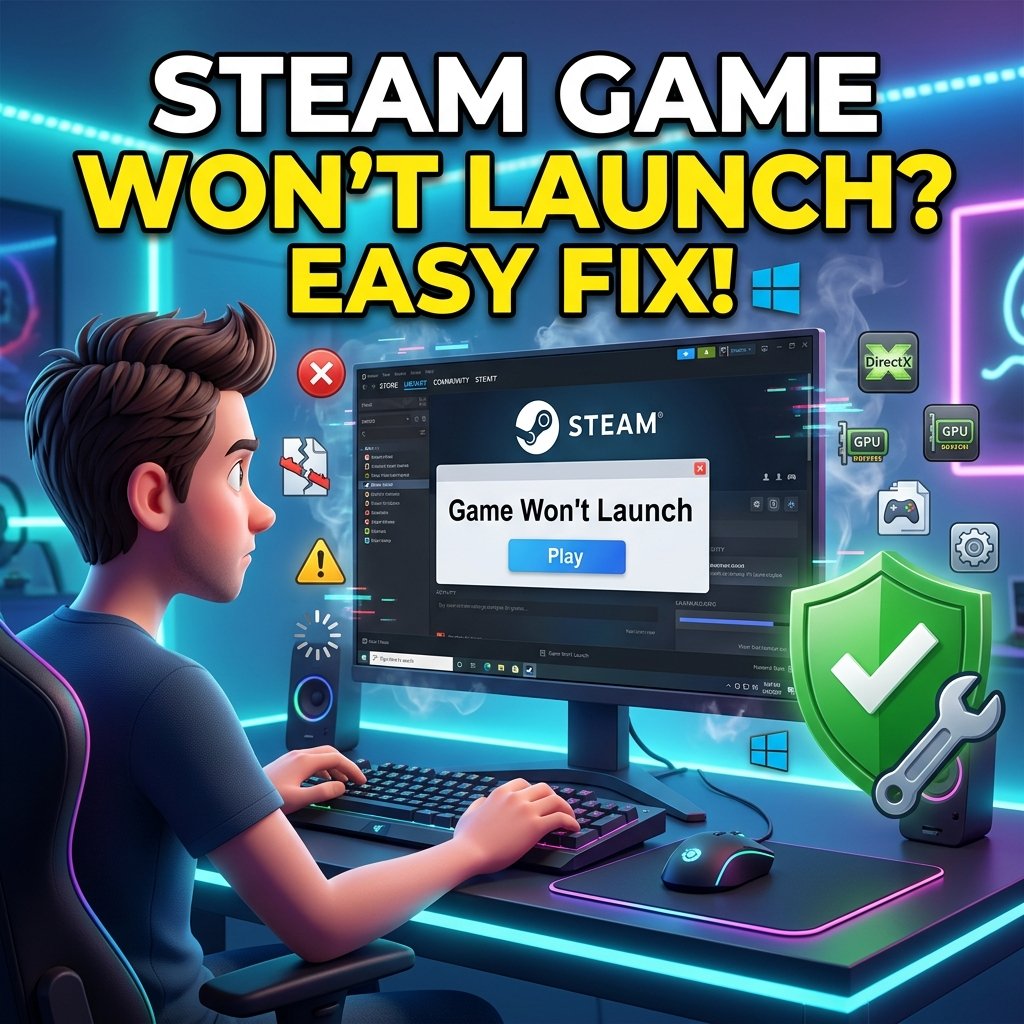
You click Play. The button grays out for a second. Then… nothing. No splash screen, no error message, no game window — just Steam sitting there like it forgot what you asked it to do.
If that sounds familiar, you’re dealing with one of the most common PC gaming headaches out there: steam games not launching on Windows. It happens to brand-new installs and to games you’ve played a hundred times before, and it’s rarely caused by just one thing. Corrupted game files, a broken download cache, an outdated graphics driver, an overzealous antivirus, or a conflict with anti-cheat software can all produce the exact same symptom — silence.
The good news is that this problem is very well understood. Most people fix it within the first three or four steps below, without reinstalling Windows or re-downloading their entire library. This guide walks through the fixes in the order they’re most likely to work, starting with a 30-second diagnostic so you’re not wasting time on a fix that doesn’t match your symptom.
Quick Diagnostic: Match Your Symptom to the Likely Cause
Before diving into fixes, it helps to narrow things down. Steam’s failure mode is almost always silent, so the way it fails is your best clue.
| Symptom | Most Likely Cause | Jump to Fix |
|---|---|---|
| Play button grays out, nothing happens | Corrupted game cache | Fix 2 |
| Steam shows “Running” but no window ever appears | Overlay or background app conflict | Fix 9 |
| Game opens, then closes instantly | Missing runtime files (VC++/DirectX) or anti-cheat failure | Fix 7 or Fix 11 |
| Stuck on “Preparing to Launch” | Steam download cache or permissions issue | Fix 3 or Fix 4 |
| Black screen right after launch | GPU driver or shader cache issue | Fix 6 or Fix 13 |
| Only one specific game won’t launch | Game-specific file corruption or a mod conflict | Fix 2 or Fix 13 |
| No Steam games launch at all | Steam client itself, Windows permissions, or antivirus | Fix 4 or Fix 5 |
If you don’t see your exact symptom, don’t worry — just work through the fixes below in order. They’re arranged from fastest/most common to more advanced.
Before You Start: Quick Checklist
A few of the fixes below only apply to specific setups, so confirm these basics first. Skipping this step is the most common reason people waste time on the wrong fix.
- Steam client is up to date. Steam auto-updates on launch, but you can confirm your version under Steam → Help → About Steam.
- Windows is current. Windows 10 version 22H2 or Windows 11 23H2/24H2 is recommended — older builds have had known game-launch regressions that were patched through 2025 and 2026.
- You have administrator access on the PC, since several repair steps require it.
- At least 50GB of free disk space. A nearly full drive can silently prevent games from writing temporary files, which looks identical to a launch failure.
Confirm Steam and Windows Are Fully Updated
Open Steam, go to Help → Check for Steam Client Updates, and let it finish before trying anything else. Do the same for Windows via Settings → Windows Update. This alone resolves a surprising number of cases, because Steam and Windows updates frequently ship fixes for exactly this kind of launch regression.
Check Steam’s Server Status (Is It Steam, Not You?)
Before you spend time troubleshooting your own PC, rule out a backend issue. Check Steam’s official support page or a site like Downdetector for widespread reports. If thousands of other players are reporting the same thing at the same time, the fix isn’t on your end — it’s a waiting game.
Confirm Your PC Meets the Game’s Minimum Requirements
Head to the game’s Steam store page and compare its listed requirements against your own hardware. This sounds obvious, but it’s an easy thing to overlook, especially with newer, more demanding titles. If your system falls short, the “launch failure” you’re seeing may actually be the game failing to initialize on unsupported hardware — no software fix will solve that.
Fix 1: Restart Steam and Your PC Properly
This is the most basic fix, and it resolves more launch issues than people expect. Steam can leave background processes running even after you’ve closed the main window, and a game’s executable can get stuck as a hidden process in Task Manager without you knowing.
Why it works: A stuck background process can block a new launch attempt from starting cleanly, especially if the game or Steam crashed unexpectedly last time.
Steps:
- Close Steam completely.
- Press Ctrl + Shift + Esc to open Task Manager.
- Look for
Steam Client WebHelper,Steam.exe, or the game’s own.exeprocess. - Right-click each one and select End Task.
- Restart your PC.
- Reopen Steam and try launching the game again.
Expected result: If a stuck process was the problem, the game should launch normally this time.
Common mistake: Closing only the Steam window instead of ending the background processes — the Steam client keeps several helper processes running that a simple window-close won’t touch.
When to move on: If the game still won’t launch after a clean restart, move to Fix 2.
Fix 2: Verify Integrity of Game Files
This is the single most effective fix for Steam games not launching, and it should always be your first real troubleshooting step.
Why it works: Steam stores a cryptographic checksum for every file in a game’s installation. When you run a file verification, Steam compares each local file against its expected hash and automatically re-downloads anything missing or damaged. A failed update, an interrupted download, or a mod that overwrote a core file can all leave a game in this broken state.
Steps:
- Open your Steam Library.
- Right-click the problem game and select Properties.
- Go to the Installed Files tab.
- Click Verify integrity of game files.
- Let Steam scan the installation — this typically takes 1–5 minutes depending on the game’s size.
Expected result: Steam automatically downloads and replaces any files that fail the check, then reports the number of files that were repaired.
What to Do If Verification Keeps “Repairing” the Same File
If you run a verify and it fixes the exact same file every single time, the repair isn’t actually failing — something else is removing the file after Steam restores it. This is almost always antivirus or endpoint protection quarantining the file the moment it lands on disk. Move on to Fix 5 to add the correct exclusions, then re-run this verify step.
Pro Tip: If you have multiple Steam library folders across different drives, check each one under Steam → Settings → Storage and make sure your antivirus exclusions cover all of them, not just your main drive.
Fix 3: Clear Steam’s Download Cache
Why it works: Steam’s download cache is meant to make updates efficient, but when it becomes corrupted, it can leave a game in a “half-believed” state — installed according to your library, but not fully prepared according to the update system. This often shows up as an endless “Updating” status or a Play button that simply won’t respond.
Steps:
- Open Steam and go to Settings → Downloads.
- Click Clear Download Cache.
- Confirm the prompt. Steam will log you out and restart.
- Sign back in and try launching the game again.
When this fix applies: Use this specifically if a game is stuck “Updating” indefinitely, or if the launch failure started right after an interrupted update, a forced reboot, or a power outage during a patch.
Common mistake: Assuming this will delete your installed games. It won’t — it only clears download metadata, not your actual game files.
Fix 4: Run Steam and the Game as Administrator
Why it works: Some games need permission to write save files, create configuration files, or install required components in protected system folders. If Windows blocks those actions, the game can fail to launch with no visible error.
Steps:
- Close Steam completely.
- Right-click the Steam shortcut and select Run as administrator.
- Click Yes if Windows prompts for permission.
- Launch the game from your Library.
Making It Permanent via Compatibility Settings
If running as administrator fixes the problem, you can make it stick so you don’t have to repeat this every time:
- Right-click the Steam shortcut and select Properties.
- Open the Compatibility tab.
- Check Run this program as an administrator.
- Click Apply, then OK.
Note: If this fix works, it’s a strong sign your issue is Windows permissions-related — pay close attention to Fix 5 as well, since antivirus and permissions issues often travel together.
Fix 5: Check for Antivirus or Windows Defender Interference
Why it happens: Antivirus software — including Windows Defender — uses behavioral heuristics to flag executables that show “suspicious” patterns. Modern game engines increasingly trigger these heuristics because they use low-level OS features for anti-cheat, memory management, and DRM. The result is that antivirus silently quarantines a game file the moment Steam downloads it, and the next launch attempt finds a missing file with no warning at all.
Adding a Steam Library Exclusion (Windows Security)
- Open Windows Security → Virus & threat protection.
- Under “Virus & threat protection settings,” click Manage settings.
- Scroll to Exclusions and click Add or remove exclusions.
- Add your entire Steam library folder (not just individual game folders), plus any secondary library locations you can find under Steam → Settings → Storage.
Controlled Folder Access and Why It Silently Blocks Games
Windows’ Controlled Folder Access feature is designed to stop ransomware, but it can also block a legitimate game from writing save data or config files — again, with no visible error. If you have this feature enabled, add Steam and your game executables to the allowed apps list under Windows Security → Virus & threat protection → Ransomware protection.
After adding exclusions, go back and re-run Fix 2 (Verify Integrity of Game Files) — Steam will re-download any files your antivirus previously quarantined.
If you use a third-party antivirus, check its documentation for the equivalent of adding a folder or process exclusion.
Fix 6: Update Your GPU Drivers (NVIDIA, AMD, Intel)
Why it works: Outdated or corrupted graphics drivers are a frequent cause of games that launch but immediately crash, or that show a black screen instead of the game window.
Steps:
- Identify your GPU manufacturer.
- Download the latest driver directly from the official source:
- Run the installer and restart your PC.
Clean-Installing Drivers with DDU When a Regular Update Isn’t Enough
If a normal driver update doesn’t resolve the issue — particularly after a recent driver release causes new problems — a clean reinstall using Display Driver Uninstaller (DDU) can help. This removes all remnants of the old driver in Safe Mode before you install the new one, which avoids conflicts that a standard “update” can leave behind. This is a more advanced step, so only use it if a normal driver update didn’t help.
If your game shows a black screen specifically, rather than crashing outright, our dedicated guide on fixing black screens when launching games walks through additional display-specific steps.
Fix 7: Reinstall Visual C++ Redistributables and DirectX
Why it happens: Many Steam games depend on Microsoft Visual C++ Redistributables, DirectX runtime components, or .NET Framework files. If one of these is missing or damaged, the game can fail silently — often showing as an instant crash right after launch.
Steps:
- Open the game’s install folder (right-click the game in Steam → Manage → Browse Local Files).
- Look for a subfolder typically named something like
_CommonRedistor_Redist. - Inside, you’ll usually find installers for Visual C++, DirectX, or other required runtimes. Run them.
- Alternatively, download the latest Microsoft Visual C++ Redistributable package directly from Microsoft to be sure you have the current version.
- Restart your PC and try launching the game again.
If the crash is specifically tied to a missing .dll file, our guide on fixing missing DLL errors in PC games goes deeper into identifying exactly which file is missing and why.
Fix 8: Remove or Reset Steam Launch Options
Why it happens: Launch options can be genuinely useful, but an outdated or incorrect command can prevent a game from starting entirely. This is especially common when players copy old FPS-boost commands or DirectX flags from outdated guides or forum threads.
Steps:
- Open Steam → Library.
- Right-click the game and select Properties.
- In the General tab, find the Launch Options box.
- Delete everything inside it.
- Close the window and launch the game.
If the game launches successfully after this, one of your old launch commands was the culprit.
Fix 9: Disable Overlays (Steam, Discord, MSI Afterburner, RGB Software)
Why it happens: Overlays are useful for screenshots, chat, FPS counters, and recording — but they inject code into the game process at a system level, and that can conflict with a game’s startup sequence, especially right after a new driver or game patch.
Why Overlay Conflicts Spiked in 2026
Community reports through 2026 have repeatedly pointed to Discord’s overlay service and Razer Synapse as common culprits in cases where a game shows “Running” in the Steam library but never actually opens a window. Both inject into processes at a system level and can block a game’s startup when their background service initializes at the same moment as the game executable.
Steps to test this:
- Disable the Steam Overlay: Steam → Settings → In-Game → uncheck Enable the Steam Overlay.
- Close Discord, MSI Afterburner/RivaTuner, and any RGB lighting software (Razer Synapse, iCUE, etc.).
- Try launching the game again with everything closed.
If the game launches, re-enable the overlays one at a time to find the specific conflict. Once you’ve identified the culprit, set it to delayed start rather than boot-time launch — most RGB and peripheral software includes this option in its settings, and it avoids the conflict without giving up the tool entirely.
Fix 10: Check Third-Party Launcher Integration (EA App, Ubisoft Connect, Rockstar Launcher)
Some games on Steam still require a secondary launcher — the EA App, Ubisoft Connect, or the Rockstar Games Launcher — to actually authenticate and start. If that secondary launcher fails to open, update, or sign you in, the game will appear to fail from Steam even though Steam itself did its job correctly.
Steps:
- Try opening the third-party launcher directly, outside of Steam, and confirm it signs in and updates normally.
- Update the launcher to its latest version if prompted.
- Restart your PC after any launcher update, then try again from Steam.
This is a distinct failure category worth checking early if your game normally requires one of these launchers — it’s easy to spend an hour on driver and file fixes when the actual problem is a stuck secondary client. If you’re dealing with this on Epic’s launcher specifically for a cross-platform title, see our guide on fixing the Epic Games Launcher when it won’t open.
Fix 11: Repair or Reinstall Anti-Cheat (Easy Anti-Cheat / BattlEye)
Why it happens: Many multiplayer games run kernel-level anti-cheat systems like Easy Anti-Cheat or BattlEye, which install their own drivers alongside the game. If that anti-cheat component becomes corrupted or falls out of sync with a Windows update, the game can crash immediately on startup or fail to launch at all.
Steps:
- Navigate to the game’s install folder.
- Look for an EasyAntiCheat or BattlEye subfolder.
- Run the official repair or installer tool included there (usually named something like
EasyAntiCheat_Setup.exe). - Restart your PC and try launching the game again.
You can also find official repair tools and troubleshooting steps directly from Easy Anti-Cheat support and BattlEye’s support site.
Warning: Don’t manually delete anti-cheat files or attempt to bypass anti-cheat checks. Beyond not fixing the underlying issue, this can trigger a ban flag in some titles. Always use the official repair tool provided by the anti-cheat vendor or the game’s own installer.
Fix 12: Rule Out Storage and Drive Problems
If Steam games consistently fail to launch from one specific drive — especially alongside slow updates, disk write errors, or repeated file-verification failures — your storage hardware itself may be the underlying issue.
Moving a Game to a Different Steam Library Folder
- Open Steam → Settings → Storage.
- Add a new library folder on a different, healthy drive.
- Right-click the affected game → Properties → Installed Files → Move Install Folder, and select the new location.
If the game launches normally from the new drive, the original drive likely has a hardware problem worth investigating with Windows’ built-in chkdsk tool or the drive manufacturer’s diagnostic software.
OneDrive and Cloud-Sync Interference With Game Folders
If your Steam library or a game’s save/config folder happens to sit inside a directory that OneDrive (or a similar cloud-sync tool) is actively syncing, file locks during sync can interfere with a game trying to read or write those same files at launch. Check whether any part of your Steam installation path overlaps with a synced folder, and exclude it from cloud sync if so.
Fix 13: Remove Mods and Check for Shader Cache Corruption
Why it happens: Mods that modify or overwrite core game files are one of the most common causes of a single game failing to launch while everything else works fine. Similarly, a corrupted shader cache — which can happen after a GPU driver update — can cause crashes or black screens specifically tied to one game’s graphics initialization.
Steps:
- Disable or remove any installed mods, then try launching the game unmodified.
- If the game uses Steam Workshop mods, unsubscribe from recently added items and relaunch.
- To clear a corrupted shader cache, check the game’s install folder for a
shadercachedirectory, or use your GPU control panel’s option to clear its shader cache (NVIDIA and AMD both offer this in their driver software).
When to move on: If removing mods and clearing the shader cache doesn’t help, the issue likely sits elsewhere — return to Fix 2 and re-verify game files.
Fix 14: Advanced Diagnostics — Event Viewer and Reliability Monitor
If none of the fixes above have worked, Windows itself keeps a record of what happened the moment your game crashed — and it’s more accessible than it sounds.
Reading a Crash Event Without a Computer Science Degree
- Press Windows + R, type
eventvwr.msc, and press Enter to open Event Viewer. - Navigate to Windows Logs → Application.
- Look for a red “Error” entry with a timestamp matching your last launch attempt.
- Click it and read the General tab — it usually names the faulting module (for example, a specific
.dllfile or driver component).
Alternatively, the Reliability Monitor (search for it in the Start menu) gives a simpler, graphical timeline of application crashes, which can be easier to scan than raw Event Viewer logs.
What to do with what you find: If the faulting module points to a specific driver or runtime file, that tells you exactly which earlier fix to revisit — a graphics driver DLL points back to Fix 6, while a Visual C++ runtime file points back to Fix 7.
Fix 15: Reinstall the Game vs. Repairing Steam (Last Resort)
If you’ve worked through the fixes above and the game still won’t launch, a reinstall may genuinely be necessary — but it should be your last step, not your first.
Repair vs. Full Reinstall — Which One First?
| Approach | Time Cost | Data Impact | Best For |
|---|---|---|---|
| Steam client repair (reinstall Steam itself) | 10–20 minutes | Game installs are untouched | Steam won’t open, or all games fail to launch |
| Single game reinstall | Varies by game size | Local saves may be lost unless cloud-synced | One specific game won’t launch after all other fixes fail |
| Full Windows repair | Hours | Minimal if done correctly | Rare — only if Event Viewer points to a broader system corruption issue |
Important: Back up any local save files before reinstalling, especially if the game doesn’t use Steam Cloud saves. If you’re worried about losing progress, our guide on recovering lost game save files is worth reading first.
If you’re dealing with a specific high-profile title, dedicated guides can save time — for example, our breakdown of GTA V not launching on PC covers causes unique to that game’s launcher setup.
When It’s Not the Game: Windows 11 vs. Windows 10 Differences
Windows 11’s tighter security defaults — more aggressive Controlled Folder Access behavior, stricter driver signing requirements, and more sensitive antivirus heuristics — mean that games which ran fine on Windows 10 can occasionally hit new permission or driver walls after an upgrade. If your launch issues started right after moving from Windows 10 to Windows 11, prioritize Fix 5 (antivirus/Controlled Folder Access) and Fix 6 (clean driver reinstall) first, since these are the two areas where the two operating systems behave most differently.
How to Prevent Steam Launch Problems in the Future
- Keep GPU drivers and Windows updated on a regular monthly cadence rather than waiting for something to break.
- Avoid installing unofficial mods or trainers that modify core game files without a clear uninstall path.
- Set overlay and RGB software to delayed startup instead of launching at boot.
- Run Verify Integrity of Game Files after major Windows or driver updates, even if nothing seems broken yet.
- Keep at least 15–20% free space on the drive hosting your Steam library to avoid silent write failures.
Key Takeaways
- ✅ Start with Verify Integrity of Game Files — it resolves the majority of launch failures on its own.
- ✅ Match your exact symptom to the diagnostic table above before troubleshooting blindly.
- ✅ Overlay software and anti-cheat conflicts are the most common 2026-specific causes, not just outdated drivers.
- ✅ Reinstalling should always be your last resort, not your first move.
Frequently Asked Questions
Why do all my Steam games suddenly stop launching at once?
This usually points to something affecting Steam itself rather than any single game — a corrupted Steam installation, a Windows permissions issue, or antivirus software blocking Steam’s core processes. Start with Fix 4 (run as administrator) and Fix 5 (antivirus exclusions).
Is it safe to delete the Steam download cache?
Yes. Clearing the download cache only removes update metadata, not your installed games. Steam will log you out and rebuild this data automatically the next time you sign in.
Why does Steam say a game is “Running” but nothing opens?
This is almost always an overlay or background software conflict — Discord, MSI Afterburner, and RGB lighting tools are the most frequently reported culprits. See Fix 9.
Do I need to reinstall a game if verifying files doesn’t fix it?
Not necessarily. Work through the driver, runtime, and anti-cheat fixes first. A reinstall is really only necessary if none of the earlier fixes resolve the issue.
Can antivirus software really block a legitimate Steam game?
Yes. Modern antivirus tools use behavioral detection that can flag legitimate game files — particularly anti-cheat components — as suspicious, quarantining them without any visible warning.
Why did my game stop launching after a Windows update?
Windows updates can occasionally change default security behavior, such as Controlled Folder Access or driver signing requirements, which can newly block a game that worked fine before. Check Fix 5 and Fix 6 first.
Does running Steam as administrator fix most launch issues?
It fixes a meaningful subset — specifically permission-related failures — but it isn’t a universal fix. If it doesn’t help within a few minutes, move on to the next fix rather than assuming it will eventually work.
How do I know if the problem is my PC and not Steam’s servers?
Check Steam’s official status channels or a service-status site for widespread reports. If many other players are reporting the same issue at the same time, it’s a backend problem you’ll simply need to wait out.
Conclusion
Steam games not launching on Windows is frustrating precisely because the failure is so silent — there’s rarely an error message telling you what actually went wrong. But the causes are well understood, and the fix is almost always somewhere in the first few steps of this guide: verifying game files, clearing a corrupted cache, updating a driver, or resolving a conflict with antivirus or overlay software.
Work through the fixes in order, use the diagnostic table if you’re not sure where to start, and save a full reinstall for last. For most players, the game is back up and running long before that becomes necessary.