
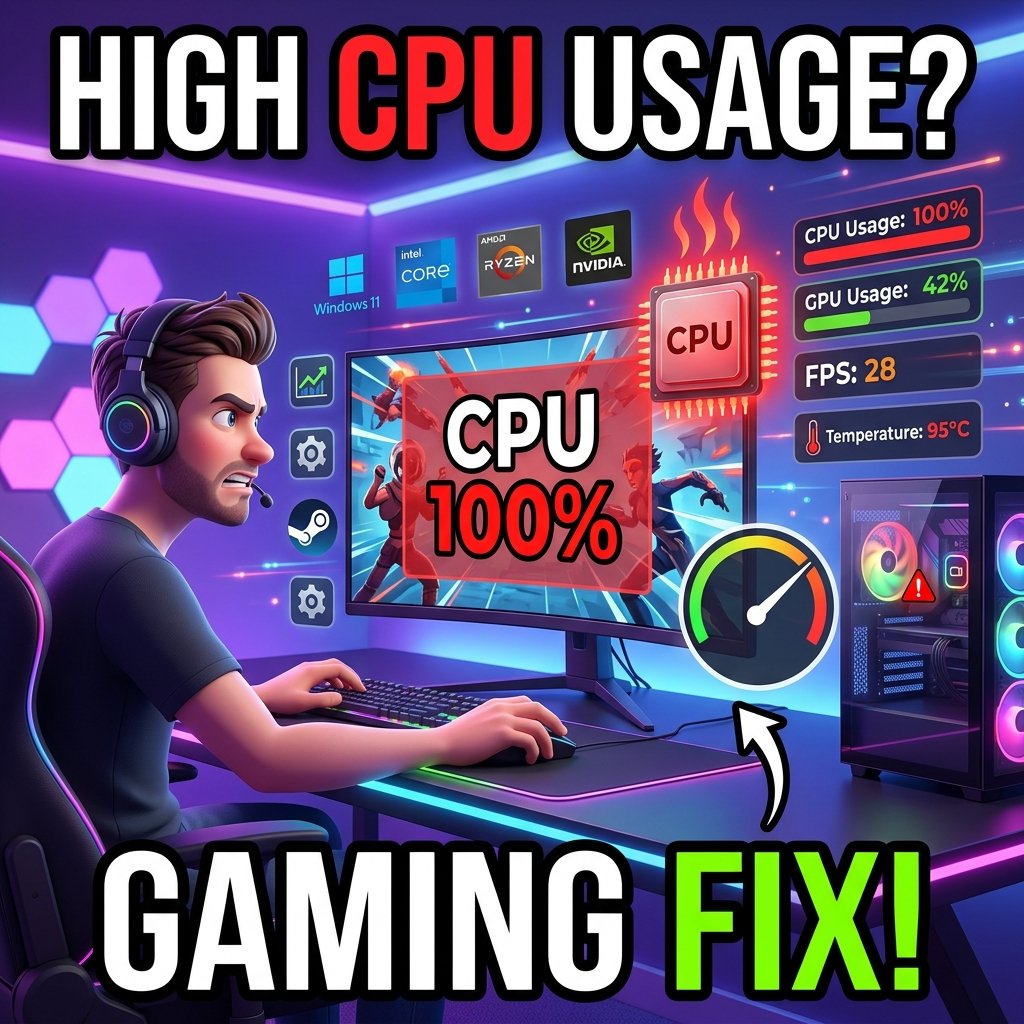
How to Fix High CPU Usage While Gaming
You’re mid-match, the frame rate suddenly falls apart, your fans sound like a takeoff runway, and when you alt-tab to Task Manager, there it is — your CPU pinned at 100%. If you’ve been searching for how to fix high CPU usage while gaming, you’re dealing with one of the most common (and most misunderstood) PC performance problems out there. The good news is that most cases are fixable in minutes, without spending a cent on new hardware or messing with risky registry hacks.
This guide walks through the real causes of high CPU usage in games — from background overlays and startup bloat to shader compilation stutter and genuine thermal throttling — and gives you a safe, ordered troubleshooting path: quick wins first, deeper Windows and driver fixes next, and hardware-level solutions only when they’re actually warranted. You’ll also learn when high CPU usage is completely normal, so you don’t waste an afternoon “fixing” something that was never broken.
Is High CPU Usage While Gaming Normal?
Not every CPU spike is a problem. Modern games lean on the processor for a lot more than just “running the game” — game logic, AI behavior, physics simulation, input handling, background asset loading, and constant communication with your graphics card all pull from the CPU. That’s why usage climbs noticeably higher in open-world games, simulation and strategy titles, and competitive multiplayer games, compared to something simpler like a 2D platformer.
Why Games Push Your CPU Harder Than Other Apps
Unlike a browser or a word processor, a game is running dozens of systems simultaneously, every single frame: AI pathing for enemies, physics for objects and ragdolls, streaming in new terrain or textures, netcode for multiplayer synchronization, and translating all of that into draw calls the GPU can render. A CPU that looks “idle” at 15% while browsing the web can easily jump to 60–90% the moment a game engine asks it to do all of that at once.
Normal vs. Problematic CPU Usage
| CPU Usage While Gaming | What It Usually Means |
|---|---|
| 30–60% | Normal for most titles; GPU is likely doing more of the work |
| 60–85% | Normal for CPU-intensive genres (open-world, strategy, sim); worth monitoring |
| 85–95%, stable, no stutter | Often fine — especially on 4–6 core CPUs in demanding titles |
| Sustained 95–100% with stuttering or frame drops | Likely a real bottleneck or background issue worth fixing |
| 100% with rising temperatures near thermal limits | Investigate cooling immediately |
Temporary Spikes vs. Sustained High Usage
A short spike to 100% when you load into a new area, launch a game, or open a menu is normal — that’s usually asset streaming or shader compilation finishing its work. The real problem is sustained high usage that doesn’t come back down once loading finishes and gameplay settles, especially if it’s paired with stutter, audio crackling, or your fans staying at full speed the entire session.
Pro Tip: Before changing any settings, play for 10–15 minutes while watching Task Manager. If usage spikes only during loading screens or the first few minutes of a new game session, that’s very likely shader compilation — not a system problem.
CPU Bottleneck vs. GPU Bottleneck — How to Tell the Difference
A CPU bottleneck happens when your processor hits its performance ceiling before your graphics card can use its full power — common when a strong GPU is paired with an older or weaker CPU. Telling the two apart is the single most useful diagnostic step you can take before changing anything.
Signs You Have a CPU Bottleneck
- CPU usage sits near 90–100% while GPU usage stays well below 100%
- FPS doesn’t improve much when you lower graphics settings (resolution, shadows, textures)
- Frame rate is noticeably better in less CPU-demanding areas of the same game
Signs You Have a GPU Bottleneck
- GPU usage sits near 100% while CPU usage is comfortably lower
- Lowering resolution or graphics settings immediately boosts FPS
- Frame rate scales predictably with visual settings
How to Check Both at Once
Open Task Manager (Ctrl + Shift + Esc) and watch the CPU and GPU graphs on the Performance tab while a game runs in windowed or borderless mode, or use an in-game overlay (NVIDIA App, AMD Software, or the Xbox Game Bar performance widget) that shows both in real time without alt-tabbing.
If you’re mainly chasing frame rate rather than CPU percentage specifically, our complete guide to fixing low FPS in PC games covers the GPU-side half of this equation in depth.
How to Properly Monitor CPU Usage While Gaming
You can’t fix what you can’t measure. Before applying any fix below, get a baseline.
Using Task Manager and Resource Monitor
Task Manager’s Performance tab gives you overall CPU usage, clock speed, and per-core activity. For a deeper look at which process is actually responsible, open Resource Monitor (search “resmon” in the Start menu) and sort the CPU tab by usage — this is how you catch a background process quietly eating cycles.
In-Game Performance Overlays
The Xbox Game Bar’s built-in performance widget, NVIDIA’s overlay, and AMD’s Adrenalin overlay can all show CPU, GPU, RAM, and FPS simultaneously without leaving the game. This is the fastest way to catch a bottleneck in real time.
What to Record Before Troubleshooting
- Idle CPU usage (before launching the game)
- CPU usage 5 minutes into gameplay
- CPU temperature under load
- Whether usage is smooth or spiky
Write these down. It sounds unnecessary until you’re three fixes deep and can’t remember if anything actually improved.
Quick Fixes First — Easiest Solutions to Try Right Now
These are the lowest-risk, highest-success fixes, and they solve the majority of cases without touching a single system setting.
Close Unnecessary Background Apps and Browser Tabs
Why this works: Modern browsers are notoriously CPU-hungry, especially with multiple tabs, extensions, or streaming video open — every open tab consumes its own share of system resources.
Steps:
- Open Task Manager and sort processes by CPU usage.
- Close browser windows, chat apps, and any software you’re not actively using.
- Relaunch your game and recheck usage.
Expected result: A measurable drop in baseline CPU usage before the game even starts. Risks: None — this only closes user-facing apps, not system processes. Common mistake: Closing a process from Task Manager instead of the app itself, which can lose unsaved work in other programs.
Disable Unused Startup Programs
Why this works: Programs that launch automatically with Windows keep running in the background and compete for CPU time throughout your session.
Steps:
- Open Task Manager → Startup Apps tab.
- Review each entry and disable anything you don’t need running constantly (chat clients, update checkers, RGB software, cloud sync tools).
- Restart your PC.
Expected result: Lower resting CPU usage and often faster boot times. Risks: Disabling security software or drivers here can cause issues — only disable apps you recognize. Verification: Compare your baseline CPU usage before and after restart.
Restart Before Long Play Sessions
Memory leaks and stuck background processes build up the longer Windows stays awake. A simple restart clears accumulated cruft that Task Manager sometimes can’t fully account for.
Check for Malware or Cryptomining Processes
Malicious software can secretly consume processor resources without your knowledge — some threats run quietly in the background, while cryptomining malware specifically uses CPU power to generate cryptocurrency. Warning signs include constant high CPU usage, unexpected overheating, and slowdowns that don’t correlate with anything you’re doing.
Steps:
- Run a full scan using Windows Security (Windows’ built-in protection).
- Follow up with a reputable second-opinion scanner if you suspect something specific.
- Remove any suspicious browser extensions or unfamiliar installed programs.
Warning: Never download unfamiliar “PC optimizer” or “CPU booster” tools promising instant fixes. Many of these bundle adware or are themselves the source of background CPU load.
Fixing Game Overlays That Cause High CPU Usage
Overlays are convenient, but they’re also background processes competing for the same CPU cycles as your game.
Xbox Game Bar and Game DVR Background Recording
Xbox Game Bar ships enabled by default on Windows 10 and 11, and its performance widgets are generally lightweight — the real cost comes from Game DVR’s background recording, which keeps a rolling capture buffer running even when you’re not actively recording, adding both CPU/GPU overhead and extra input latency. Disabling background recording specifically (rather than the whole overlay) is usually enough to recover the difference in CPU-bound titles.
Steps:
- Press
Windows + Ito open Settings, then go to Gaming. - Select Xbox Game Bar and turn off “Open Xbox Game Bar using this button on a controller” if you don’t use it.
- Go to Captures and turn off “Record in the background while I’m playing a game.”
Expected result: Reduced background CPU/GPU load, particularly noticeable in CPU-limited games. Verification: Recheck your Task Manager baseline with the game running.
Steam Overlay
If you don’t use Steam’s in-game chat or overlay features, disable it under Steam → Settings → In-Game by unchecking “Enable the Steam Overlay while in-game.” This is also a useful step if you’ve had trouble with games not launching properly — see our guide on Steam games not launching on Windows if disabling the overlay doesn’t resolve a launch issue.
Discord Overlay
Discord’s in-game overlay runs its own rendering layer on top of your game. Disable it under User Settings → Game Overlay if you don’t need on-screen voice indicators.
NVIDIA and AMD In-Game Overlays
Both NVIDIA’s app overlay and AMD’s Adrenalin overlay offer performance monitoring and instant replay features that use some CPU and GPU encoder resources. If you’re already using another capture tool, disabling the redundant one avoids doubling up on background recording.
Testing Overlays One at a Time
Don’t disable everything at once. Turn off one overlay, play for ten minutes, and check your baseline. This tells you which overlay (if any) was actually responsible, instead of guessing.
Windows-Specific Fixes for High CPU Usage
Power Plan: High Performance vs. Balanced
Windows’ Balanced power plan can throttle CPU clock speeds to save power, which occasionally shows up as inconsistent performance in games. Switching to High Performance (or the equivalent “Best Performance” plan in newer Windows builds) removes that ceiling.
Steps:
- Search “Choose a power plan” in the Start menu.
- Select High Performance (click “Show additional plans” if it’s hidden).
- Restart your game.
Risks: Slightly higher power draw and heat output — noticeable mainly on laptops running off battery.
Enabling Game Mode
Windows’ Game Mode prioritizes your game process for CPU and GPU scheduling and can help most on systems with fewer CPU cores. Enable it under Settings → Gaming → Game Mode.
Hardware-Accelerated GPU Scheduling (HAGS)
HAGS allows Windows to offload part of GPU scheduling work from the CPU to a dedicated processor on the graphics card, which can lower CPU overhead in CPU-bound games. According to Microsoft’s official guidance, it requires a GPU and driver combination that supports WDDM 2.7 or higher, so the toggle simply won’t appear on unsupported hardware.
Steps:
- Go to Settings → System → Display → Graphics → Advanced Graphics Settings.
- Toggle Hardware-Accelerated GPU Scheduling on.
- Restart your PC.
Expected result: Slightly lower CPU overhead in CPU-limited games, especially with newer NVIDIA/AMD cards. Risks: A small number of setups see stutter after enabling it — this is a genuine “test it yourself” feature, not a guaranteed win. If performance gets worse, simply toggle it back off.
Disabling Background Windows Indexing During Gameplay
Windows Search indexing periodically scans files in the background, which can cause brief CPU spikes on lower-core-count systems. You can pause indexing temporarily via Settings → Privacy & Security → Searching Windows, or exclude your game library folders from indexing entirely.
Checking for Problematic Windows Updates
Occasionally, a specific Windows update introduces a regression affecting background CPU usage or driver compatibility. If high CPU usage started right after an update, check Windows Release Health notes or roll back the update from Settings → Windows Update → Update History → Uninstall updates as a temporary measure while a fix is issued.
Windows 11 vs. Windows 10 Differences
Windows 10 lets you fully disable Xbox Game Bar from Settings; Windows 11 doesn’t offer a single toggle to remove it entirely, so restricting its background permissions (as covered above) is the more reliable approach on Windows 11.
Driver and Software-Related Fixes
Updating GPU Drivers
Outdated GPU drivers can force more work onto the CPU by missing game-specific optimizations. Always download directly from NVIDIA’s official driver page or AMD’s official Adrenalin software page rather than third-party “driver updater” tools.
Updating Chipset Drivers
Chipset drivers govern how your CPU communicates with memory, storage, and other components. An outdated chipset driver can introduce inefficiencies that show up as unexplained CPU load. Get these from your motherboard manufacturer’s support page, or use Intel’s official Driver & Support Assistant if you’re on an Intel platform.
BIOS Updates — Only When Officially Recommended
Warning: Only update your BIOS if your motherboard manufacturer specifically recommends it for a known issue — for example, a CPU compatibility fix or a documented power-management bug. Updating BIOS incorrectly, or interrupting the process, can make your PC unbootable. Always follow your motherboard manufacturer’s official instructions exactly, and never update BIOS mid-troubleshooting “just in case.”
Antivirus Impact on Gaming Performance
Real-time antivirus scanning can spike CPU usage, particularly during full-system scans or when scanning large game files during loading. Most antivirus software (including Windows Security) lets you add game folders as scan exclusions — check your antivirus vendor’s official documentation for the safe way to do this rather than disabling protection entirely.
RGB Software and Other “Always-On” Utilities
RGB lighting control software, peripheral management apps, and similar always-running utilities are minor individually but add up. If you’re running Corsair iCUE, Razer Synapse, Logitech G Hub, and similar tools simultaneously, check whether any offer a lightweight “background mode” or can be closed when not actively customizing settings.
Shader Compilation Stutter — A Different Kind of CPU Spike
This is one of the most misunderstood causes of “high CPU usage” because it looks identical to a system problem but is actually a normal part of how modern game engines work.
What Shader Compilation Stutter Actually Is
When a game encounters a visual effect, material, or object for the first time, the engine has to compile the shader program needed to render it — a process that briefly spikes CPU (and sometimes GPU) usage. If dozens of new shaders are needed at once, like when you enter a new area, you’ll see a hitch or frame freeze rather than a smooth spike.
Unreal Engine 5 and PSO Precaching
Unreal Engine 5 games are especially prone to this because Nanite and Lumen require compiling a large number of shader variations. According to Unreal Engine’s own technical documentation, the engine’s Pipeline State Object (PSO) precaching system has evolved specifically to prevent most shader-compilation stutters by compiling shaders ahead of time rather than mid-gameplay — though the effectiveness depends on how well the individual game implemented it.
Unity Engine Behavior
Unity handles this differently: it tends to compile shaders during scene loading rather than mid-gameplay, which shows up as a longer loading screen rather than an in-game freeze — a better overall experience even though it’s fundamentally the same underlying process.
What Players Can Actually Do About It
- Let the game finish an initial “shader pre-compilation” or “optimizing shaders” step on first launch if one is offered — don’t skip it.
- Keep GPU drivers current, since driver-level shader caching (accessible in NVIDIA Control Panel or AMD Software) can reduce recompilation on future launches.
- Avoid judging performance during the first few minutes of a new game or major patch — spikes here are often shader-related, not a system fault.
Pro Tip: If CPU usage spikes only during the first playthrough of a new area, wait until the shader compilation pass finishes before judging or benchmarking performance.
Game-Specific and Genre-Specific Causes
Open-World Games
Constant streaming of terrain, NPCs, and physics objects keeps the CPU consistently busier than in linear titles — some elevated usage here is expected.
Simulation and Strategy Games
Games simulating large numbers of units, economies, or AI agents (city builders, grand strategy, colony sims) are frequently CPU-bound by design, since this workload doesn’t parallelize onto the GPU the way rendering does.
Competitive Multiplayer Games
Netcode, anti-cheat systems, and tick-rate processing add consistent CPU overhead in online games. If you’re troubleshooting multiplayer performance more broadly — including connection issues alongside CPU load — our ping and latency calculator can help you rule network problems in or out alongside these CPU fixes.
Corrupted Game Files and Broken Updates
A partially downloaded update or corrupted installation can cause a game to behave erratically, including abnormal CPU spikes as it tries to recover missing data mid-session. If you suspect this, our guides on fixing corrupted game installation files and installation failed errors walk through verifying and repairing game files safely. If a download itself is the problem, see Steam download stuck at 0% for a related fix.
Hardware-Related Fixes
Cleaning Dust From Fans, Vents, and Heatsinks
Dust accumulation is the most common trigger of thermal throttling, blocking airflow and forcing your cooling system to work harder for the same result.
Steps:
- Power off and unplug the PC completely (remove the laptop battery if possible).
- Use compressed air in short bursts, holding the can upright, to clear vents and heatsink fins.
- For desktops, open the side panel and clean dust filters and fan blades directly.
Expected result: Lower idle and load temperatures, more stable clock speeds. Risks: Tilting a compressed air can may spray liquid propellant onto components — always keep it upright.
Recognizing Thermal Throttling
If your CPU or GPU consistently hits 90–95°C under load and you can see clock speeds dropping well below the processor’s base frequency, your cooling system needs attention — this is the processor deliberately slowing itself down to avoid damage.
When Repasting Is (and Isn’t) Worth It
Thermal paste dries out over years of heat cycles, and this genuinely reduces cooling performance — but it’s a step to take after confirming dust cleaning and airflow aren’t the problem, based on a measurable pattern like repeated throttling or shutdowns, rising fan noise, or 90°C+ readings on repeated tests.
Warning: Repasting involves removing your CPU’s heatsink and applying a small amount of thermal compound directly to the die. If you’re not comfortable opening your PC or laptop, this is a reasonable job to have a technician handle — improper application or reassembly can cause worse temperatures than before.
Multi-Core Utilization and SMT/Hyper-Threading
Not every game engine spreads work evenly across all available cores — some older or poorly optimized titles lean heavily on one or two cores even on 8+ core CPUs, which can show high usage on specific cores while others sit idle. This is a game engine limitation more than something you can fix from the settings menu.
Recording Software and Streaming (OBS) Impact
Software encoding in OBS Studio is CPU-intensive by design. If you’re streaming or recording and seeing high CPU usage, switching your encoder setting from “x264” (software/CPU) to your GPU’s hardware encoder (NVENC for NVIDIA, AMF for AMD, Quick Sync for Intel) shifts that load off the CPU entirely.
Advanced Troubleshooting
Clean Boot to Isolate Third-Party Conflicts
A clean boot starts Windows with a minimal set of drivers and startup programs, which helps isolate whether a specific third-party app is responsible for background CPU load. Search “System Configuration” (msconfig), go to the Services tab, check “Hide all Microsoft services,” then disable the rest and restart to test.
Checking Reliability Monitor / Event Viewer
Search “Reliability Monitor” in the Start menu to see a timeline of crashes, driver failures, and warnings — useful for spotting a recurring software conflict you might otherwise miss.
Testing With a Clean Windows Installation
As a genuine last resort, a clean install removes accumulated system bloat and misconfigured settings that can silently affect CPU usage over years of use. Back up your data and create Windows installation media directly from Microsoft’s website before attempting this.
When to Suspect Failing Hardware vs. Software
If high CPU usage persists after a clean install with no other software installed besides drivers, that points strongly toward hardware — either thermal throttling or a genuinely underpowered CPU for the games you’re running.
When You Should Actually Upgrade Your CPU
Software fixes have limits. If you’ve worked through the steps above and are still seeing sustained high CPU usage with low, unstable frame rates, especially in CPU-demanding genres, the processor itself may simply be the bottleneck.
| Sign | Software Fix Likely Enough? | Upgrade Worth Considering? |
|---|---|---|
| Spikes only on loading/new areas | Yes | No |
| High usage in one specific game only | Maybe (check game-specific fixes) | Maybe |
| High usage across nearly all modern titles | No | Yes |
| CPU is 5+ years old, paired with a modern GPU | No | Yes |
| Temperatures and background apps are already clean | No | Yes |
When upgrading, pair the CPU with adequate RAM and a GPU that won’t itself become the new bottleneck — an upgrade only helps if the rest of the system can keep up with it.
Preventive Maintenance to Avoid Future CPU Issues
- Clean dust from vents and fans every few months, more often if you have pets or live somewhere dusty.
- Keep GPU and chipset drivers current, but avoid updating mid-session before an important match.
- Periodically review startup apps and installed overlays — software you added six months ago for one specific game may still be running in the background today.
- Make temperature and CPU-usage monitoring a habit, not just something you check when something already feels wrong.
Common Myths About CPU Usage in Games
“100% CPU usage always means something is wrong.” Not true — some games, especially simulation and strategy titles, are intentionally CPU-bound by design, and sustained high usage without stutter or overheating isn’t inherently a problem.
“Disabling all overlays always boosts FPS.” Overlays vary widely in cost. Lightweight performance widgets barely register, while background recording features carry a real cost — the fix is targeted, not blanket disabling everything.
“More cores always means better gaming performance.” Many games still don’t scale evenly across high core counts; per-core speed and how well the specific engine threads its workload often matter more than raw core count.
“Registry tweaks and ‘CPU optimizer’ tools fix high usage.” Most of these either do nothing measurable or disable services you actually need. The safe fixes in this guide use Windows’ own built-in settings — no third-party download required.
Frequently Asked Questions
Is 100% CPU usage bad while gaming?
Not necessarily. It’s expected during loading screens, shader compilation, and in CPU-heavy genres. It becomes a concern only when it’s sustained, paired with stuttering, or accompanied by rising temperatures.
Why does my CPU usage spike only in certain games?
Different engines place different demands on the CPU — open-world, simulation, and multiplayer titles typically use more CPU by design than smaller, linear games.
Does Xbox Game Bar cause high CPU usage?
The overlay’s widgets are generally lightweight, but its background recording feature (Game DVR) can add real CPU and GPU overhead even when you’re not actively recording.
Should I disable Hardware-Accelerated GPU Scheduling?
Try it both ways. It helps many systems, especially with newer NVIDIA/AMD cards, but a small number of setups see stutter after enabling it — treat it as a setting worth testing rather than assuming either state is correct.
Why is my CPU usage high but FPS is low?
This is the classic signature of a CPU bottleneck — your processor is maxed out before your GPU has a chance to fully render frames. Lowering graphics settings alone usually won’t fix this since the GPU isn’t the limiting factor.
Can antivirus software cause high CPU usage in games?
Yes, particularly during active scans. Adding your game folders as scan exclusions (through your antivirus’s official settings, not by disabling protection) usually resolves it.
How do I know if I need a new CPU?
If you’ve ruled out overlays, background apps, drivers, and overheating, and still see consistently maxed-out CPU usage with poor frame rates across most modern games, the processor itself is likely the limiting factor.
Conclusion
High CPU usage while gaming is rarely a mystery once you work through it in order: rule out what’s normal, check background processes and overlays, verify Windows and driver settings, and only then look at cooling or hardware as the culprit. Most players fix the problem entirely with the free, built-in steps in this guide — no registry hacks, no paid “optimizer” software, and no guesswork required. Work through the sections above in order, verify each change before moving to the next, and you’ll know exactly what fixed it instead of hoping something did.



2 Comments