
Epic Games Login Error: Why It Happens and How to Fix It (2026)
|

Epic Games Login Error: Why It Happens and How to Fix It (2026)

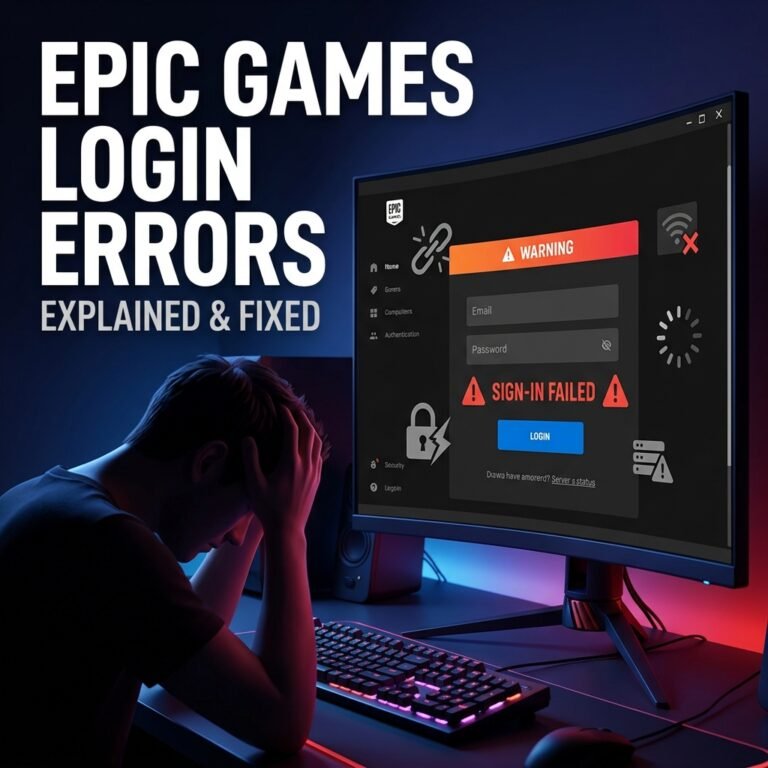
You’re trying to sign in to Epic Games and something’s blocking you — an error message, a blank failure, or a screen that just loops you back to login. An Epic Games login error can come from several different places: your account, Epic’s servers, your browser, or the Launcher itself. The fix depends entirely on which one you’re dealing with, which is why generic “restart your PC” advice so often misses the actual problem.

This guide walks through the specific error messages Epic Games documents, what each one actually means, and the order in which to troubleshoot them — starting with the check that takes ten seconds and can save you from resetting things that were never broken.

Start Here: Is the Problem on Epic’s End?

Before changing anything on your device, check whether Epic’s own systems are having a problem. Epic tracks login-related incidents separately from other services like matchmaking or downloads, and outages do happen — including regional ones that only affect certain countries.

Visit the Epic Games Public Status page and look specifically at the Login and Epic Online Services components. This page has recorded real, dated login incidents — including one that affected players in a specific region for roughly half an hour, and separate scheduled maintenance windows for Epic Online Services. If the Login component shows anything other than “Operational,” that’s very likely your answer, and no amount of cache-clearing or DNS-flushing on your end will fix it faster.

If Epic’s status page shows an outage or degraded performance: wait it out. Reconfiguring your firewall, reinstalling the Launcher, or resetting your password during a confirmed outage won’t help and can create new problems (like an unnecessary password reset) without fixing the original one.

If the status page shows everything operational: the problem is very likely on your side — account, browser, network, or Launcher — and the rest of this guide will help you narrow it down.

Common Epic Games Login Error Messages, Explained

Epic documents a specific set of error messages in its own support library. If you’re seeing one of the messages below, this is the fastest path to a fix, since Epic itself tells you what causes it.

“Invalid Credentials”

What it means: The email and password combination you entered doesn’t match what’s on file.

Why it happens: This is usually a simple mismatch — a typo, an old saved password, or autofill inserting the wrong stored login. Less obviously, a keyboard set to a non-default language can silently alter what you’re typing.

What to do:

  • Double-check you’re using the correct email address for the account, not a similar one you also own
  • Reset your password through Epic’s Forgot Password page
  • If you’re confident the credentials are correct but still get this error, disable browser autofill and confirm your keyboard is set to your default language

“There was an error logging you in, please try again”

What it means: Epic’s sign-in system rejected the attempt without a more specific reason.

Why it happens: This message is officially associated with VPN, proxy, or hosting-service connections. Epic’s authentication system can flag traffic coming through these services as suspicious.

What to do:

  • Disconnect from any VPN, proxy, or hosting service and try again
  • Confirm your email and password are correct
  • If it persists, reset your password and sign in again with the new one

“The security code is invalid or expired” (2FA)

What it means: The two-factor authentication code you entered didn’t validate.

Why it happens: For email or SMS codes, this is almost always a timing issue — codes expire quickly, and entering an old one from a previous message is a common mistake. For authenticator app codes, Epic identifies an out-of-sync device clock as the most common cause, since authenticator codes are generated based on the current time.

What to do:

  • For email/SMS: wait 30 seconds, request a new code, and enter it immediately — check your spam folder if it doesn’t arrive
  • For authenticator apps: make sure your device’s date and time are set to sync automatically, then try the next generated code
  • If none of that works, select Try another way on the sign-in screen to switch 2FA methods

“SMS is not available”

What it means: SMS-based 2FA can’t be delivered to your phone number.

Why it happens: This happens when your carrier or region isn’t supported for SMS delivery — it’s a known limitation, not a bug specific to your account.

What to do: Select Try another way and use email verification or an authenticator app instead. Once signed in, you can update or remove SMS as a 2FA method from your account’s Password and Security settings.

“Something went wrong. Please refresh the page and check that you allow cookies on your device.”

What it means: Your browser blocked cookies the sign-in page needs to function.

Why it happens: Ad blockers, privacy extensions, or strict cookie settings can interfere with Epic’s login page, which relies on cookies to track the sign-in session.

What to do, in order:

  1. Refresh and try again — if your session simply timed out, this alone can fix it
  2. Confirm cookies are enabled in your browser
  3. Temporarily disable ad blockers or privacy extensions, then retry
  4. Try a different browser or a fresh browser window

“Sorry, you are visiting our service too frequently, please try again later”

What it means: A temporary rate limit triggered by too many sign-in attempts in a short window.

Why it happens: This is an automated anti-abuse measure, not an account-specific block.

What to do: Wait a few minutes and try again. If it persists, wait 24 hours. Epic Games Support cannot manually clear this restriction faster — it resets automatically.

“Sorry, your account has too many active logins”

What it means: Your account is already signed in on more devices than allowed simultaneously.

What to do: Sign out on another device, then try signing in again.

“Sorry, your account is inactive and may not log in”

What it means: The account requires a recovery process before it can be used again.

What to do: Follow Epic’s account recovery steps rather than trying to force a normal sign-in.

“Sorry, you currently have your account set to be deleted. You can reactivate it.”

What it means: A deletion request is pending on the account.

Why it happens: Epic gives accounts a 14-day window from the deletion request before the deletion becomes permanent.

What to do: If you’re still within that window, use the reactivate option shown with the error to cancel the deletion and regain access.

“Incorrect response. Please refresh the page.”

What it means: Depends on when you see it. If it appears while linking a console account, it means the password entered for that link attempt was wrong. If it appears while simply signing in, Epic’s own guidance is direct: this requires a support ticket, since it isn’t something you can resolve through standard troubleshooting.

The Epic Games Login Loop

If you keep getting returned to the login screen after signing in — with no error message, just a repeating loop — this is a distinct problem from the error messages above.

What causes it: Epic Games attributes this to cached session data or cookie conflicts, either in your browser or inside the Epic Games Launcher itself. The Launcher stores session information locally, and when that cache becomes inconsistent, it can fail to recognize a successful login.

How to fix it: Clear the Launcher’s web cache:

  1. Fully close the Epic Games Launcher (check your system tray — it often keeps running in the background after you close the window)
  2. Open File Explorer and go to %localappdata%\EpicGamesLauncher\Saved
  3. Delete the webcache folder (and webcache_4147 if present)
  4. Restart your computer and relaunch the Epic Games Launcher

If the loop happens in a browser instead of the Launcher, try signing in from an incognito or private window first — if that works cleanly, clearing your regular browser’s cookies for epicgames.com will likely resolve it there too.

Two-Factor Authentication Lockouts

Losing access to your 2FA method is different from simply mistyping a code — this is what to do when you can’t generate a valid code at all, for example after losing your phone or switching authenticator apps.

Officially documented recovery options:

  • Email verification fallback — On the 2FA prompt, select Try another way, then choose to send a code to your account email instead
  • Backup codes — If you saved the backup codes provided when you first set up 2FA, you can use one of them the same way
  • Once you’re back in, go to your account’s Password and Security settings to update or replace your 2FA method

If you’ve lost access to every 2FA method and don’t have backup codes, this overlaps with full account recovery, covered below.

Account Credential and Access Issues

Forgotten password: Use Epic’s Forgot Password flow directly — don’t try to guess or reuse an old password repeatedly, since Epic’s rate limiting will eventually block further attempts.

Unverified new account: If you created your account recently, check the confirmation email sent at signup. An unverified email address is a common, overlooked reason a brand-new account has trouble signing in cleanly.

“You already have an account, please sign in”: This means the email you’re trying to use is already tied to a different Epic Games account. It’s not an error with your login attempt — you’ll need to either sign in to the existing account or use a different email if you intended to create a new one.

Console and Cross-Platform Login Errors

If you’re linking a PlayStation, Xbox, or Nintendo account and get “You previously linked a different [platform] account to your Epic Games account,” it means you’re logged into the wrong console account, or one that isn’t the one you use with Epic Games. Try signing in with the Sign in with email option instead of the console-linking option, or open the Epic Games sign-in page in an incognito window to rule out a stuck session.

If you instead see “This account for [platform] is already linked to another Epic Games account,” your console is already tied to a different account than the one you’re expecting. Signing in through an incognito browser window using your console credentials will show you which Epic account it’s actually linked to.

Firewall, Antivirus, and Network Issues

If the Launcher itself struggles to connect — not just to sign in, but to reach Epic’s servers at all — the cause is often local network software rather than your account.

Security software occasionally misidentifies the Launcher’s background connections as suspicious. As a diagnostic step, you can temporarily disable third-party antivirus protection to see if sign-in succeeds. If it does, the correct long-term fix is adding the Epic Games Launcher as an exception in your antivirus and firewall rather than leaving protection off — Microsoft’s official guide to adding a security exclusion in Windows Security walks through this safely for Windows Defender.

A stale DNS cache or an unintended system proxy can also block the Launcher’s connection to Epic’s authentication servers. Flushing DNS is a low-risk step worth trying if login attempts hang or time out rather than returning a clear error:

  1. Open Command Prompt as an administrator
  2. Run ipconfig /flushdns
  3. Restart the Launcher and try signing in again

If you’re using a VPN, disconnect it first — Epic’s own error text for failed logins explicitly calls out VPN and proxy connections as a common trigger.

Repairing or Reinstalling the Launcher

These are more invasive steps and should come after the account, cache, and network checks above — not before them.

Repair re-verifies the Launcher’s installed files and can resolve corruption-related crashes, but it does not reset your account authentication, cached login session, or network configuration. If your problem is specifically about signing in rather than the Launcher crashing or failing to open, a repair is unlikely to help on its own — if the Launcher itself won’t even open, that’s a related but separate issue covered in our guide on Epic Games Launcher won’t open problems.

Reinstalling should be treated as a last resort. Epic’s current installer will remove your installed games during the process, so exhaust the steps above first.

Is This Actually a Phishing Attempt?

If you received an email, message, or link claiming to be from Epic Games asking for your password or a security code, treat it with suspicion before assuming it’s a legitimate login prompt.

Epic Games states plainly that it will only ask for your password on official Epic Games login pages and will never request it by email, message, or through a third-party site. The display name on an email can be faked entirely — Epic’s own guidance is to check the actual sending domain rather than trusting the name shown, since a message can say “Epic Games” and still come from an unrelated address.

If you’re ever unsure whether a request is genuinely from Epic, don’t enter any credentials. Go directly to epicgames.com yourself and check your account status there instead of clicking through the message.

My Account May Be Compromised

If someone else appears to have accessed your account — changed your password, changed your linked email, or you’re simply locked out unexpectedly — this needs a slightly different path than a routine login error.

  1. Secure your email first. Your email is effectively the master key to your Epic account. If you still have access to it, change its password and enable 2FA there too.
  2. Try linked accounts. If you have a console or social account (PlayStation, Xbox, Nintendo, Facebook, Google) linked to your Epic account, signing in through that linked account can get you back in even if your Epic password no longer works.
  3. If you get in but the email was changed to one you don’t control, signing in alone isn’t enough to secure the account — proceed to a formal recovery request, since whoever accessed it could change the email back.
  4. If none of that works, submit an account recovery request.

How to Recover a Locked or Inaccessible Account

Epic’s account recovery process is structured in stages, and it’s designed to work even if you’ve lost access to your original email:

  1. Epic first attempts to verify your identity through your existing 2FA methods
  2. If that’s not possible, it falls back to verifying the original account email
  3. If you don’t have access to that email either, you’ll be directed to a Lost access to this email address path, which asks for additional account details

If those steps don’t restore access, Epic’s account recovery request form asks for whatever identifying information you have — your Account ID, an Invoice ID from a past purchase, any email address ever used on the account, your display name, or a linked console/social account. You can skip fields you don’t have; providing more accurate information simply makes the account easier to locate.

When to Contact Epic Games Support Directly

Most of the errors covered above are self-resolvable. A few genuinely aren’t, and research into Epic’s own documentation confirms these require a support ticket rather than further self-troubleshooting:

  • The “Incorrect response. Please refresh the page.” error appearing during a normal sign-in attempt (not while linking a console)
  • Account recovery attempts that fail even after completing the full recovery form
  • Any situation where you suspect unauthorized access and can’t regain control through the steps above

Frequently Asked Questions

Why can’t I log into Epic Games?

It depends on which layer is failing — your credentials, your 2FA method, Epic’s servers, your browser’s cookies, or the Launcher’s local cache. Checking Epic’s status page first, then matching your exact error message to the list above, is the fastest way to narrow it down.

How do I know if Epic Games is down?

Check the Epic Games Public Status page and look at the Login and Epic Online Services components specifically. Regional and partial outages do happen and won’t necessarily show as a full site-wide outage.

Why does Epic Games keep asking me to log in (login loop)?

This is typically caused by cached session data or a cookie conflict in your browser or the Launcher. Clearing the Launcher’s web cache is the documented fix.

What should I do if my Epic Games 2FA isn’t working?

If a code is rejected, check whether your device’s clock is set to sync automatically — this is the most common cause for authenticator app failures. If you’ve lost your 2FA method entirely, use the email-verification fallback or a saved backup code.

Can a VPN cause Epic Games login errors?

Yes. Epic’s own troubleshooting text for the “There was an error logging you in” message specifically instructs users to disconnect from VPN, proxy, or hosting services before retrying.

Can DNS or firewall settings cause Epic Games login problems?

They can, particularly if the Launcher can’t reach Epic’s servers at all rather than showing a specific credential or account error. These are worth checking after you’ve ruled out account-side and server-side causes, not before.

When should I contact Epic Games Support instead of continuing to troubleshoot?

When you’re facing an error Epic explicitly documents as requiring a ticket, or when the standard account recovery form hasn’t restored access.

Conclusion

Most Epic Games login errors trace back to one of four places: a credential or account issue, an expired or misconfigured 2FA method, a server-side problem on Epic’s end, or a local cache, cookie, or network conflict. Starting with Epic’s status page and then matching your exact error message to the explanations above will get you to the right fix faster than working through a generic checklist — and it’ll stop you from reinstalling the Launcher or resetting your password when the real problem was never on your device at all.

If you’ve worked through the relevant section here and you’re still stuck, that’s the point where contacting Epic Games Support directly, rather than continuing to try local fixes, is the right next step.

Similar Posts

Leave a Reply

Your email address will not be published. Required fields are marked *